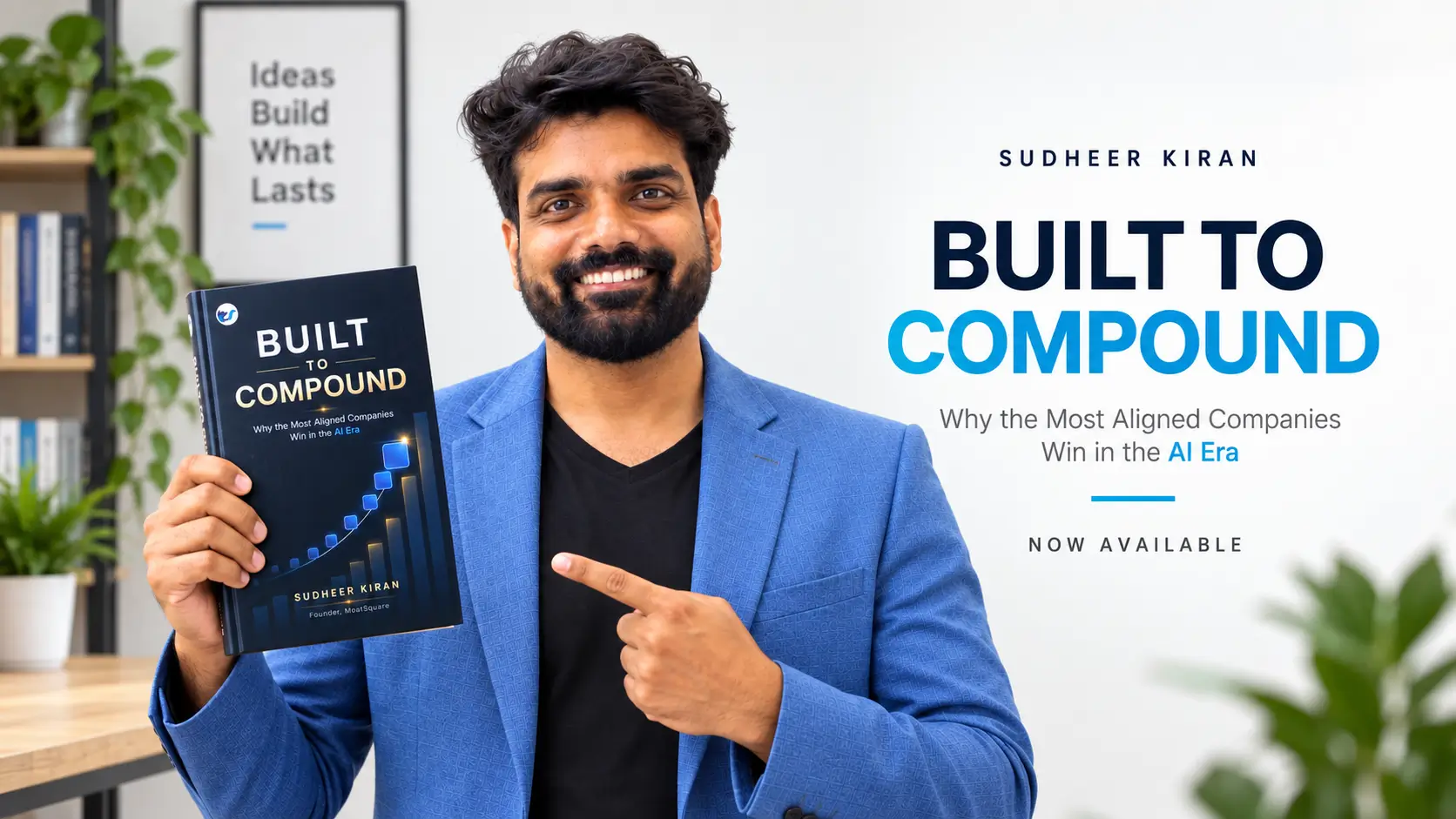
Strategy Isn't a Plan. It's a Position.
In 15 years of doing marketing, I've seen companies chase shiny things, burn time, kill momentum, and lose focus. I've done it myself.
Chasing big TAM. Rebranding too soon. Switching messaging mid-cycle. All in the name of agility. But looking back, it wasn't agility. It was a lack of clarity.
Because real strategy isn't reactive. It's not about what's trending or what your competitors are doing. Strategy is about who you're becoming.
Don't Chase Shiny Objects: Lessons from the Winners
Seth Godin said it best: "Chasing the shiny objects doesn't work for dogs and it doesn't work for people. If the dog catches the car, it's still unhappy. The whole idea is to find a thing you want to stand for and place you want to stand for and you stick with it and you get better at it."
Real-World Example: Calendly's Unwavering Focus
When Calendly launched in 2013, the scheduling space was already crowded. Microsoft Outlook had scheduling features. Google Calendar existed. Dozens of scheduling tools were available.
But Calendly didn't try to be a full calendar replacement or a comprehensive CRM. They focused on one thing: eliminating the back-and-forth emails to schedule meetings. That's it.
While competitors added chat features, task management, and email marketing tools, Calendly stayed laser-focused on scheduling. They could have easily expanded into project management or added video conferencing capabilities early on. Instead, they perfected their core function.
The result? Calendly now serves over 20 million users and was valued at $3 billion in their 2021 funding round. Their positioning is so clear that "send me a Calendly link" has become common business language.
The Salesforce Playbook: Win, Then Dominate
The gold standard for this approach is Salesforce. They didn't launch in 1999 as "the complete business platform." They focused obsessively on one thing: cloud-based CRM that was easier than traditional on-premise solutions.
For years, they resisted adding marketing automation, customer service tools, or analytics platforms. They just got really, really good at CRM. Only after becoming the undisputed leader in cloud CRM did they begin their strategic expansion into Sales Cloud, Service Cloud, Marketing Cloud, and eventually an entire ecosystem of business applications.
This win-first-then-expand strategy is what built Salesforce into a $250+ billion company. They earned the right to expand by first proving they could dominate one category completely.
The Pattern: Focus, Win, Expand Intelligently
The lesson isn't "never expand"—it's about timing and sequence. Companies that try to be comprehensive from day one become everything to no one. But companies that focus intensely, win their core category, build trust and market position, then expand strategically into adjacent areas—those companies build lasting empires.
There will always be something newer or flashier to chase. But if you shift every time a trend appears, you lose your identity. You lose your focus. You become someone no one remembers.
Stick to the Change You're Here to Make
Another example given by Seth Godin in a podcast – imagine you open a gluten-free bakery. Every item on your menu is made without wheat, barley, or rye so that people with celiac disease and gluten sensitivities can enjoy your treats worry-free. Your brand lives and breathes "zero gluten."
Now picture your most loyal customer strolling in every morning. Today, they grin and say, 'Could you bake me a rich chocolate-layer cake? I'm craving it—I really need it today.'
You could say yes. You'd make one happy customer right away. But once you start putting gluten back into your bakery—even for just one regular—you break the promise that brought people through your door in the first place. That "gluten-free sanctuary" status vanishes.
SaaS Example: ConvertKit's Strategic Saying "No"
Nathan Barry's ConvertKit faced this exact dilemma. When they were growing, enterprise customers kept asking for advanced CRM features, complex automation workflows, and sales pipeline management.
The tempting move? Build those features. Capture that enterprise revenue. Expand the TAM.
Instead, ConvertKit said no. They stayed focused on their core promise: email marketing tools built specifically for creators and bloggers. They knew that if they tried to compete with Salesforce or HubSpot on enterprise features, they'd lose what made them special.
This focus paid off. ConvertKit grew from $4M to $29M ARR between 2017-2021, specifically because creators knew exactly what ConvertKit stood for. When a blogger needs email marketing, ConvertKit is the obvious choice—not because they do everything, but because they do one thing exceptionally well for a specific audience.
The Drift Messaging Pivot That Worked
Drift provides an interesting counter-narrative. They started as an email marketing tool but made a strategic pivot to conversational marketing and chatbots. However, this wasn't chasing a shiny object—it was recognizing that their true value proposition was about real-time customer engagement, not just email.
The key difference: they didn't add chat as another feature. They became the chat company. They repositioned entirely around conversational marketing and doubled down on that positioning. This strategic shift led to their $1.1 billion valuation.
The lesson: pivoting can work, but only when you're moving toward clearer positioning, not away from it.
Before you know it, your roadmap isn't yours. Your positioning is gone. If you let customers change your strategy, you end up serving no one well. Be clear on the value you deliver. Stick to it. The people who need you will remember you because of it — not in spite of it.
Growth Works Like Nature: The Compound Effect of Consistency
You don't plant a seed today and expect a tree tomorrow. Yet in SaaS, we act like launching a new feature or running a flashy ad should create instant growth. It doesn't.
Strategy is the seed. Positioning is the soil. Consistency is the water. Focus is the sunlight.
Example: Notion's 6-Year Overnight Success
Notion launched in 2016, but most people think they "suddenly" became popular in 2020. The reality? They spent four years consistently improving their core product and messaging around "all-in-one workspace" before hitting mainstream adoption.
They didn't chase project management trends when Asana was hot. They didn't pivot to team chat when Slack was growing. They didn't add video features during the remote work boom. They just kept getting better at being the flexible, all-in-one workspace they set out to be.
By 2021, they reached a $10 billion valuation—not through pivots or feature chasing, but through relentless consistency in their positioning and execution.
The Zoom Story: 10 Years of Being "Easy Video Conferencing"
Zoom launched in 2011 when Skype dominated video calling, WebEx owned enterprise conferencing, and Google Hangouts had massive distribution advantages. Instead of trying to out-feature the giants, Zoom focused on one thing: making video conferencing that just works.
For nearly a decade, they consistently delivered on this promise. Better audio quality. More reliable connections. Easier setup. While competitors added whiteboards, file sharing, and complex enterprise features, Zoom perfected the core experience.
When the pandemic hit in 2020, guess which video tool everyone turned to? Not the one with the most features, but the one that consistently delivered on their core promise. Zoom's daily meeting participants jumped from 10 million in December 2019 to 300 million in April 2020.
Your brand won't grow unless you feed it what it needs, consistently, over time. If you keep digging it up to check progress or chase a hotter idea, it never gets the roots it needs to thrive.
You can't become memorable if you keep reinventing yourself.
Focus > TAM: Why Smaller Markets Can Mean Bigger Success
When someone says, "There's more TAM over there," they're not helping you grow. They're tempting you to become generic.
TAM is meaningless if you're just another option. You win by focus. By saying no. By being the one product in a category that actually stands for something.
Example: Figma vs. The Design Tool Giants
When Figma launched in 2016, Adobe Creative Suite dominated design with a massive TAM. Sketch owned UI design on Mac. InVision had prototyping. The logical advice would have been to avoid the "small" collaborative design space.
Instead, Figma focused on one specific problem: design collaboration in the browser. They made it easy for entire teams—designers, developers, product managers—to work together on designs in real-time.
Adobe had more features, more market share, and more resources. But Figma had focus. They became synonymous with collaborative design. When teams needed to work together on design, Figma was the obvious choice.
Result? Adobe acquired Figma for $20 billion in 2022—the largest acquisition in Adobe's history. Figma's focused positioning made them more valuable than trying to compete across Adobe's entire TAM.
The Airtable Approach: Database + Spreadsheet Focus
Airtable could have tried to compete with Excel's massive user base or Salesforce's CRM dominance. Instead, they focused on the intersection: "spreadsheet-database hybrid for non-technical teams."
This seems like a smaller market than "all spreadsheet users" or "all database users." But by owning this specific positioning, Airtable reached a $11.7 billion valuation. They became the go-to solution for teams who needed more than Excel but found traditional databases too complex.
Every time you chase the next big thing, you leave behind what made you matter in the first place.
AI Will Change Everything — But Don't Let It Change You
AI is changing the world. Dramatically. It will reshape SaaS. It will touch every workflow, every team, every process.
But if you're not careful, it becomes another distraction — a new excuse to shift focus, dilute messaging, and spin your wheels again.
Example: How Grammarly Integrated AI Without Losing Focus
Grammarly has been using AI for writing assistance since 2009, long before it was trendy. When large language models exploded in popularity, they could have pivoted to become "AI writing assistant for everything."
Instead, they stayed focused on their core promise: helping people write better. They integrated advanced AI capabilities, but always in service of their original positioning. They didn't become a general AI tool; they became a better writing tool that happens to use AI.
Their consistency paid off. While dozens of new "AI writing tools" launched and struggled to differentiate, Grammarly maintained their clear positioning and continued growing their user base past 30 million.
Counter-Example: The AI Feature Gold Rush
In 2023, seemingly every SaaS tool added "AI-powered" features. Customer support tools added AI chatbots. Project management tools added AI task suggestions. CRM tools added AI lead scoring.
Most of these features felt tacked on because they were. Companies were chasing the AI trend rather than using AI to strengthen their core positioning. The result? Feature bloat that confused customers instead of adding clear value.
Use AI to automate the mediocre: draft copy, repurpose content, sort leads. Use AI to help customers become better at what they do — not just engage more but achieve more. Use AI to build faster, work smarter, and free up time for deep, strategic work.
But never let it distract you from what you're trying to become. Your strategy doesn't change because a new tool showed up. Your focus doesn't vanish because a competitor added a chatbot.
AI is the assistant, not the author, of your vision.
Be Consistent. That's How You Build Trust
Everyone talks about being authentic. But in business, consistency is the key.
Show up with the same voice, the same mission, the same message. Improve it, refine it, evolve it — but don't change it just because the market did.
Example: Mailchimp's Consistent Personality
Mailchimp has maintained the same quirky, approachable brand personality for over two decades. While email marketing got more sophisticated and enterprise-focused, Mailchimp stayed true to their "email marketing for everyone" positioning.
Their consistent voice—friendly, slightly irreverent, always helpful—made them instantly recognizable. Even as they added advanced features and grew into a full marketing platform, their core personality remained unchanged.
This consistency built trust with small businesses who saw Mailchimp as the approachable alternative to complex enterprise tools. They grew to over 12 million users and sold to Intuit for $12 billion in 2021.
Buffer's Transparency Consistency
Buffer built their brand around transparency and simplicity in social media management. For over a decade, they've maintained this positioning through product updates, leadership changes, and market shifts.
They publish their revenue, employee salaries, and internal metrics publicly. This radical transparency became their differentiator in a space full of black-box social media tools. Customers trust Buffer because they've consistently delivered on their transparency promise.
Consistency earns trust. Trust compounds over time.
Yes, It's a Game. But Play It With Purpose
Marketing is a game. Growth is a game.
But the best players don't cheat. They play with intention.
Example: Patagonia's Purpose-Driven Growth
Patagonia could maximize short-term revenue by promoting fast fashion or cheap outdoor gear. Instead, they've consistently positioned themselves around environmental responsibility and product durability.
Their "Don't Buy This Jacket" campaign actually drove more sales because it reinforced their authentic commitment to sustainability. Their purpose-driven positioning created a loyal customer base willing to pay premium prices for values alignment.
This approach built a $1 billion company that customers see as a movement, not just a brand.
If your product, your funnel, or your onboarding is designed to help people become who they want to be, that's a game worth playing. That's still strategy. That's still growth.
You can play to win and still build with integrity.
In a Crowded Market, Clarity Wins
Everyone's talking more. Launching more. Building more.
But more isn't the answer.
Clarity is.
The Stripe Example: Win First, Then Expand
When Stripe launched in 2010, the payments space was dominated by PayPal and traditional merchant services. Instead of trying to beat them on features or pricing, Stripe focused on one clear position: "payments infrastructure for developers."
Their positioning was so clear that developers immediately understood the value. While PayPal focused on consumer transactions and traditional processors buried developers in paperwork, Stripe made it simple for developers to add payments to applications.
This laser focus on developer experience led to Stripe becoming one of the most valuable private companies in the world, with a $95 billion valuation. But here's the key lesson: only after winning the payments category is Stripe now expanding into billing infrastructure, financial services, and business banking.
They didn't launch as "financial infrastructure for everyone." They became the undisputed leader in developer payments first, earned trust and market position, then used that foundation to expand logically into adjacent areas. Their expansion makes sense because it serves the same developers they already won, just with more comprehensive solutions.
Know who you're for. Know what you're here to change. Know the one game you're playing to win first—then you can expand into adjacent games from a position of strength.
Don't build for everyone. Don't pivot for noise. Don't chase a bigger TAM at the expense of first dominating your core category. Win where you are, then expand where it makes sense.
Because at the end of the day, only one thing matters:
What do you want to be remembered for — and by whom?
That's strategy. That's positioning. That's the only way forward.
FAQs
Q: How do I know if my positioning is too narrow?
A: If you can clearly articulate who your ideal customer is and they recognize themselves in your messaging, it's not too narrow. Figma focused on "collaborative design," Calendly on "scheduling," and ConvertKit on "creator email marketing"—all seemed narrow but built billion-dollar companies.
Q: What if a competitor copies our positioning?
A: Positioning isn't just messaging—it's product decisions, feature priorities, and customer experience. True positioning runs deep and takes years to build authentically. Copycats usually fail because they're copying the surface, not the substance.
Q: How long should I stick with positioning before pivoting?
A: Give it at least 18-24 months of consistent execution before considering changes. Most positioning "failures" are actually execution or patience failures. Notion took 6 years to hit mainstream success with the same core positioning.
Q: Should I ever expand beyond my core positioning?
A: Absolutely—but only after you've won your core category. Stripe expanded from payments to billing infrastructure after dominating developer payments. Mailchimp added social media tools after winning small business email marketing. Salesforce built an entire ecosystem after conquering CRM. The key is earning the right to expand by first proving dominance in your initial focus area. Expand too early, and you become everything to no one.
Q: How do I resist customer requests that don't fit our positioning?
A: Create a clear decision framework. Before adding any feature, ask: "Does this make us better at our core promise or does it make us more generic?" Share your positioning internally so everyone can make aligned decisions.
Q: What if our market changes dramatically?
A: Focus on serving your customers' evolving needs within your positioning, not changing your positioning to chase new markets. Zoom stayed "easy video conferencing" as remote work exploded, just serving that need at massive scale.
Q: How do I measure if our positioning is working?
A: Track brand awareness in your specific category, customer acquisition cost trends, pricing power, and most importantly—can prospects immediately understand what you do and why they need you? If explanation is required, positioning needs work.
TLDR: The Strategic Positioning Playbook
Core Principle: Strategy is position, not plan. Focus beats flexibility in crowded markets.
Key Actions:
- Pick one thing to be known for and stick with it
- Say no to features that dilute your core promise
- Use consistency as your competitive advantage
- Let AI enhance your focus, not distract from it
- Build for specific people, not everyone
Success Metrics: Brand recall, customer loyalty, pricing power—not just growth rate.
Bottom Line: In a noisy market, the clearest voice wins. Your positioning is your moat.

Written by Sudheer Kiran
Full Stack Growth Marketing Professional & Fractional CMOHey, I'm Sudheer. I've spent nearly two decades working in growth marketing—mostly with B2B SaaS companies, agencies, and startups. I help businesses find smart, scalable ways to grow through digital transformation, brand strategy, and marketing that actually converts.