
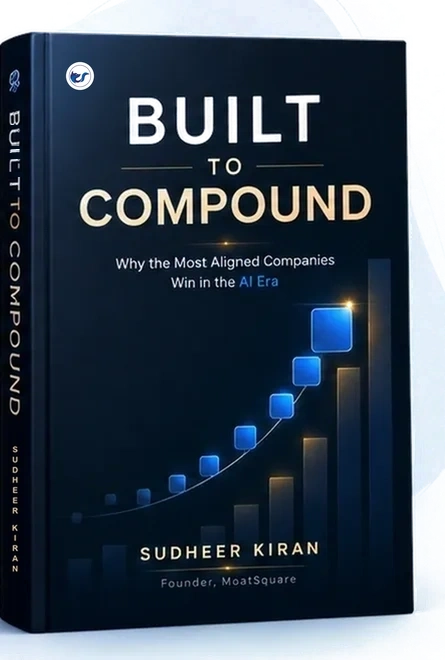
Built to
Compound
Why the Most Aligned Companies
Win in the AI Era
AI has made execution cheaper.
Alignment is becoming the advantage.
“Sustainable growth is no longer an execution problem—it is an alignment problem.”
Execution is Commoditized.
Coherence Is the Only Moat.
AI has made execution cheaper, faster, and more accessible than ever. The real advantage now comes from alignment — connecting strategy, people, product, and go-to-market into a compounding system.
The Trap of
“Competent-Looking Sameness”
Generative AI allows any marketing team to scale campaign volume and content production at zero marginal cost. But when everyone can produce high-volume noise, visibility ceases to differentiate. Teams scale activity while trust quietly evaporates.
Trust as Machine-Readable
Infrastructure
71% of B2B hidden buyers decide before speaking with a sales rep, and AI discovery engines (ChatGPT, Perplexity, Google AI Overviews) evaluate entity consistency rather than keyword density. Trust is no longer a soft PR metric — it is your operational infrastructure.
Designing for Strategic Gravity
Compounding companies do not just run marketing campaigns; they build self-reinforcing systems where positioning, product experience, customer onboarding, and authority continuously feed into each other to create natural market pull.
The 6 Frameworks of Compounding Growth
Introduced sequentially across the book to give executive teams an actionable, shared language for modern growth architecture.
to compounding
results.
The Coherence Gap
The measurable distance between what a company claims about itself, what its operations deliver, and how the market and AI engines perceive both.
Trust Infrastructure
Trust is no longer a soft PR metric—it’s functional infrastructure across six verifiable surfaces: partner validation, platform consistency, security disclosures, operational transparency, executive voice, and employee voice.
Commercial Control Points
Owned, defensible strategic assets (e.g., Stripe’s documentation, HubSpot Academy, Trailhead) that strengthen with usage and operate independently of rented platforms or changing algorithms.
Semantic Authority & Entity Trust
As traditional keyword search declines, discoverability depends on machine-readable entity trust and semantic consistency across the web graph.
Designed Growth
The deliberate architecture where positioning, product capability, authority, discoverability, and customer experience continuously reinforce one another over time.
Strategic Gravity
The natural market pull created when coherence reaches critical mass. Customers convert faster, discovery happens organically, and acquisition ceases to depend on constant interruption.
16 Chapters Across 5 Strategic Parts
Each part concludes with executive offsite diagnostic questions designed for immediate board and team alignment.
blueprint for
compounding growth.
The Fragmentation Era
Understand how we got here—and why traditional marketing no longer compounds.
- •Chapter 1: Marketing Was Never One Thing
- •Chapter 2: Marketing Is Not a Department. It’s an Ecosystem.
- •Chapter 3: Why Visibility No Longer Wins
Why Growth Breaks
Identify the hidden misalignments that prevent marketing, product, and sales from compounding.
- •Chapter 4: Why Strategy Alone Doesn’t Compound
- •Chapter 5: Product Is the Growth System
- •Chapter 6: Random Acts of Marketing
The Alignment Advantage
Design the systems, processes, and operating model for compounding growth.
- •Chapter 7: Trust Infrastructure
- •Chapter 8: Strategic Reinforcement
- •Chapter 9: Commercial Control Points
- •Chapter 10: Why Remarkable Companies Feel Coherent
AI, Discoverability & Future
Prepare for an AI-native go-to-market world where discoverability, entity trust, and machine readability define growth.
- •Chapter 11: When Coherence Looks Wrong
- •Chapter 12: AI Discoverability Infrastructure
- •Chapter 13: Entity Trust and Semantic Authority
- •Chapter 14: Pattern Recognition as Strategic Advantage
Built to Compound
Bring it all together—a practical roadmap to design, execute, and sustain strategic gravity.
- •Chapter 15: Adaptive Alignment
- •Chapter 16: Building Strategic Gravity
Who Should Read Built to Compound
Tailored blueprints for executive leaders responsible for enterprise value and long-term commercial resilience.
A shared ambition —
compound growth.

B2B Founders & CEOs

CMOs & Heads of Growth

Product & CPO Leaders

GTM & RevOps Executives
What Tech Founders & Growth Leaders
Are Saying
Early endorsements from B2B SaaS executives, agency founders, and growth practitioners who reviewed the book.
from builders,
operators, and
growth leaders.
“What makes Built to Compound stand out isn’t the AI angle — it’s the underlying argument about how advantage actually accumulates. Sudheer’s central claim is that companies winning in the AI era are doing something structurally different: their positioning, operations, trust, and go-to-market aren’t just coordinated, they’re reinforcing each other in ways that build over time. That’s a simple idea with complicated implications, and Sudheer works through it with unusual precision.”


“BUILT TO COMPOUND nails what most strategy books miss: enduring advantage isn’t built from isolated tactics; it’s compounded from systems that work together. A genuinely useful read for anyone leading growth in today’s fragmented marketing landscape.”

“I spend my days in the unglamorous layer of growth, fixing what’s quietly capping a site before adding anything new, rebuilding trajectories that took months to bend the wrong way. So I read Built to Compound nodding the whole way through. Sudheer names something practitioners feel but rarely articulate — the work that compounds is almost never the work that spikes. This is the rare strategy book that respects how growth actually happens on the ground.”

A thoughtful and well-structured book that challenges how growth teams operate at a fundamental level.

Great products fail to compound when positioning is disconnected from onboarding reality. This book provides a clear framework to fix that.
Built to Compound points towards a critical friction layer that slows down acquisition for so many SaaS companies: the gap between what their product actually does, what they claim it does, and how the market ends up interpreting it. A compelling case for a more strategic and integrated go-to-market approach.

Everything You Want to Know
About Built to Compound
Quick answers to the most common questions about the book, its audience, and how it can help you.
to help you
get started.
Join the Most Aligned Companies
in the AI Era
Stop treating marketing as a set of disconnected campaigns and start building an integrated commercial system that gets stronger over time.
Get Your Copy Today
Available in print and digital formats worldwide.