Sudheer Kiran
Sudheer Kiran
Marketing Consultant • Fractional CMO
Marketing the Internet by Sudheer Kiran - 3D Perspective Edition
446 Pages•10 Parts•50 Chapters•54 Field Tools
VOL. 4 • SYSTEMS & AGENTICNEW RELEASE • AMAZON LIVE

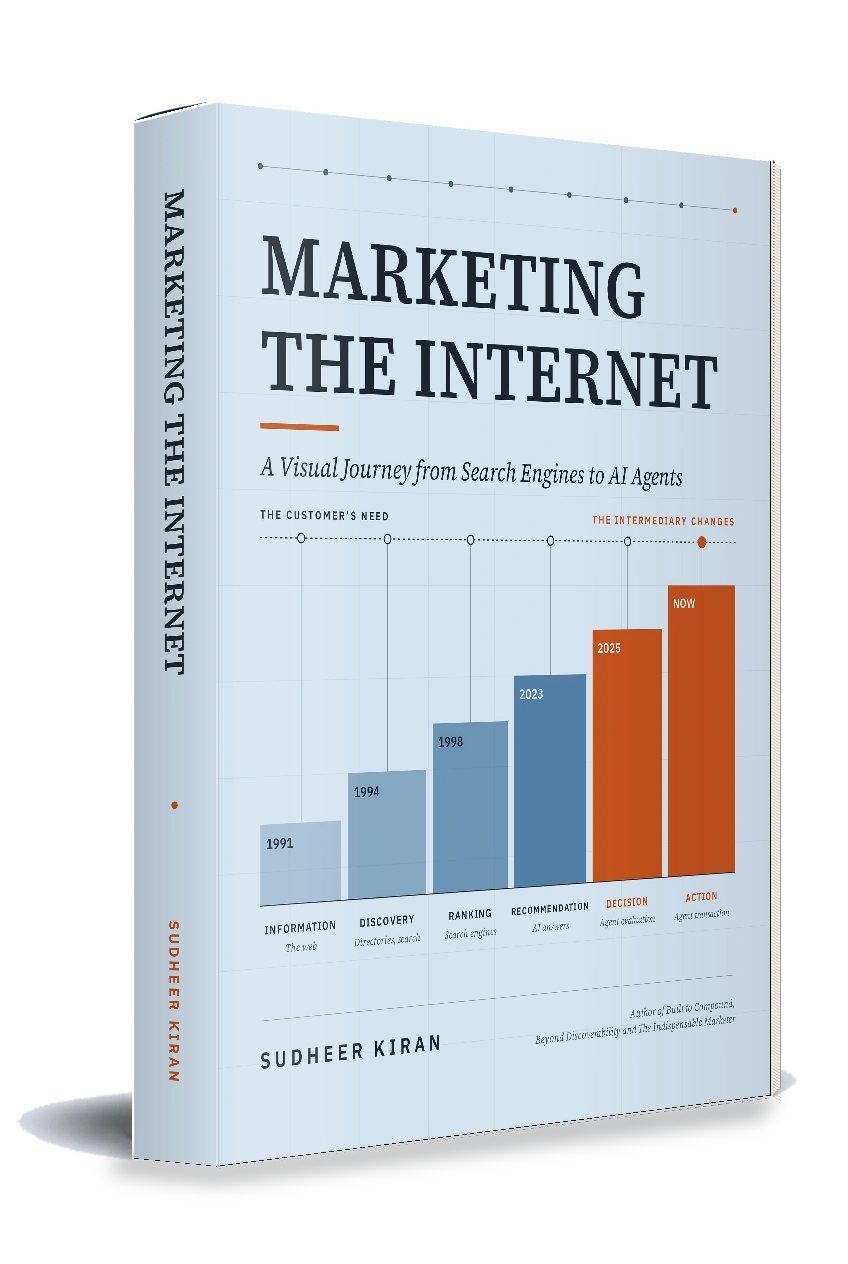
Marketing the Internet: A Visual Journey from Search Engines to AI Agents

A Visual Journey from Search Engines to AI Agents

Every era of digital marketing was a response to a discovery problem, and every response created the next one.

Every era of digital marketing was a response to a discovery problem, and every response created the next one. Marketing the Internet tells that story as one connected system—from first principles to agentic marketing—built to be seen as much as read with timelines, system maps, canvases, and an evidence ledger of rated claims.

Order on Amazon
Hardcover & Paperback Available Worldwide
01The Discovery Chain ReactionFrom web directories to search crawlers, inbound content, answer engines, and autonomous buyer bots—every breakthrough responded to an information bottleneck.
02Visual Systems & First PrinciplesUnderstand digital marketing mechanisms through visual system maps, algorithmic pipelines, Master Canvases, and interactive mental models designed to be seen as much as read.
03The Claims Evidence LedgerAn unsparing framework rating 129 core marketing claims from documented facts to open questions, equipping you to evaluate ranking factors and hype for yourself.
THE CORE LAW OF DIGITAL MARKETING

Every Era Solved a Bottleneck—and Created the Next One

Digital marketing was never a collection of isolated hacks. It is a single connected chain reaction spanning 30+ years:

ERA 1 • 1990s

Directories

Websites needed to be found, so human-curated directories like Yahoo! cataloged pages until the web grew too fast to manually index.

ERA 2 • 2000s

Search & SEO

Crawlers and PageRank took over. Businesses demanded that ranking, giving birth to technical SEO, paid Google Ads, and link building.

ERA 3 • 2010s

Social & Inbound

Feeds, algorithmic timelines, content marketing, lifecycle email, and analytics stacks saturated every traditional human attention channel.

ERA 4 • 2020s

Answer Engines (AEO)

Generative AI and RAG write direct answers before anyone clicks a blue link. Discoverability requires entity authority in model latent space.

ERA 5 • TODAY & BEYOND

Autonomous Agents

Software agents evaluate, verify claims, compare specs, negotiate pricing, and buy on the customer’s behalf. Machine readability is the new moat.

CURRICULUM & ARCHITECTURE

10 Parts • 50 Visual Chapters

446 pages moving systematically from marketing first principles to agentic commerce, backed by timelines, workflows, and evidence scorecards.

Part 1

Marketing

How marketing worked before the web, and which timeless principles still govern modern commercial advantage.
Chapter 1
What Marketing Is For
The core commercial imperative: creating, communicating, and capturing value.
Chapter 2
Customers Before Channels
Understanding customer jobs, psychology, and buying journeys before picking platforms.
Chapter 3
Markets, Demand and Alternatives
Market sizing, competitive alternatives, and latent vs. active demand dynamics.
Chapter 4
Positioning, Value and Messaging
Structuring distinct value propositions that command attention and pricing power.
Chapter 5
Attention and Distribution Before the Web
Historical media models, broadcast economics, and lessons that survive algorithm shifts.
Chapter 6
What Do We Actually Know?
Separating empirical marketing science from popular dogma and passing tactical fads.
Part 2

The Internet

The architectural plumbing of the internet and how web systems translate into commercial revenue.
Chapter 7
From Network to Web
The evolution of protocols: ARPANET, TCP/IP, HTTP, and the birth of the open World Wide Web.
Chapter 8
How the Web Works
DNS resolution, client-server requests, DOM rendering, and response latency explained simply.
Chapter 9
The Website as a Business System
Moving beyond static brochureware to conversion funnels, intent capture, and tracking nodes.
Chapter 10
The Channel Map
Comprehensive topology of digital distribution paths: earned, owned, shared, and paid.
Part 3

Discovery and Search

The emergence of search engines as the central routing layer of human commercial intent.
Chapter 11
The Discovery Problem
Why manual directories failed to scale and created the mathematical need for automated indexing.
Chapter 12
How Search Works
Crawling, parsing, tokenization, index construction, and query expansion demystified.
Chapter 13
Links, Google and the Search Economy
PageRank, hyperlink graph mathematics, and the monetization of transactional intent.
Chapter 14
Search Behavior and Intent
Navigational, informational, commercial, and transactional query journeys.
Part 4

SEO

Search Engine Optimization from first-principles mechanics to advanced technical authority.
Chapter 15
The SEO System
The holistic architecture balancing technical accessibility, content relevance, and domain trust.
Chapter 16
Research: Keywords, Topics and Entities
Moving from raw search volume strings to semantic topic clusters and knowledge entities.
Chapter 17
Technical SEO
Crawl budgets, rendering pipelines, internal link graphs, canonicalization, and Core Web Vitals.
Chapter 18
Content and On-Page
Searcher satisfaction, semantic structure, depth, internal routing, and UX formatting.
Chapter 19
Authority and Reputation
Backlink topologies, digital PR, brand search volume, and real-world citation graphs.
Chapter 20
SEO in Context
Local search, ecommerce architecture, and international multi-lingual optimization.
Chapter 21
What Do We Actually Know About Ranking?
Unpacking official algorithm documentation, patents, API leaks, and vendor studies.
Chapter 22
Measuring and Testing SEO
SEO split-testing, rank tracking reality, cannibalization audits, and log file analysis.
Part 5

Ecosystem

Connecting paid media, content, email, CRM, and ABM into one unified commercial operating system.
Chapter 23
Content as a Compounding Asset
Structuring owned media that builds durable equity instead of single-spike traffic.
Chapter 24
Paid Search: Buying Intent
Auction mechanics, quality scores, bidding algorithms, and high-intent keyword acquisition.
Chapter 25
Paid Social, Display and Video: Buying Attention
Programmatic ad exchanges, visual interruptions, audience targeting, and creative fatigue.
Chapter 26
Social, Communities and Creators
Dark social, community affinity, creator partnerships, and decentralized word-of-mouth.
Chapter 27
Partners and Affiliates
Channel economics, co-marketing alignments, affiliate ecosystems, and marketplace placement.
Chapter 28
Email, Lifecycle and CRM
List hygiene, trigger-based automations, segmentation, and lifetime value expansion.
Chapter 29
ABM and B2B Demand Systems
Target account lists, multi-stakeholder consensus buying, and coordinated sales-marketing orchestration.
Chapter 30
Conversion
Friction audits, cognitive ergonomics, behavioral economics, and conversion physics.
Chapter 31
The Ecosystem as a System
Synthesizing disconnected channels into a self-reinforcing flywheel with zero waste.
Part 6

Measurement

Rigorous analytics, causal attribution, and navigating signal loss in a privacy-first web.
Chapter 32
Analytics: What the Tools Actually See
Session boundaries, cookies, event models, and client vs. server-side tracking limits.
Chapter 33
The Measurement Plan
Aligning executive KPIs, pipeline metrics, leading indicators, and instrumentation.
Chapter 34
Attribution and Incrementality
First-touch, last-touch, multi-touch modeling, and why incrementality testing trumps credit claims.
Chapter 35
Experimentation
A/B testing statistics, statistical significance, minimum detectable effect, and test velocity.
Chapter 36
Privacy and Signal Loss
Cookie deprecation, consent mode, server-side tracking, and modeled attribution reality.
Part 7

Meaning

The semantic revolution: how algorithms shifted from matching strings of text to understanding entities and things.
Chapter 37
From Strings to Things
Knowledge graphs, entity extraction, Wikidata, and structured schema architecture.
Chapter 38
Machines That Learn Relevance
Vector embeddings, neural search, transformer models, RankBrain, and BERT in practice.
Chapter 39
Search Starts Answering
Featured snippets, zero-click queries, direct knowledge panels, and shrinking organic clickthroughs.
Part 8

AI Search

Generative answers, synthetic summaries, and how Answer Engine Optimization (AEO/GEO) operates.
Chapter 40
How Generative Answers Are Built
Retrieval-Augmented Generation (RAG), citation selection, hallucination bounds, and synthesis.
Chapter 41
The Vocabulary Problem
Demystifying AEO, GEO, LLMO, and AI search visibility without marketing buzzwords.
Chapter 42
The AI Search Landscape
Deconstructing ChatGPT Search, Perplexity, Google AI Overviews, Claude, and Gemini.
Chapter 43
AI Visibility
What causes an AI model to cite, quote, or recommend your brand in generated answers.
Chapter 44
What Holds Up
Testing AI SEO vendor claims against empirical evidence and real platform behavior.
Part 9

Agents

From static answers to autonomous software agents that evaluate, shortlist, and buy on behalf of buyers.
Chapter 45
From Answers to Actions
The emergence of personal and enterprise research agents with tools and browsers.
Chapter 46
How Agents Discover, Evaluate and Act
Autonomous web browsing, specification comparison, pricing extraction, and checkout.
Chapter 47
Trust, Verification and Delegation
How autonomous software validates trust signals, third-party audits, and brand claims.
Part 10

Agentic

Agentic marketing strategy and the five career habits for thriving in the autonomous era.
Chapter 48
Agentic SEO and the Machine-Readable Business
Structuring your website into an API-first interface equipped for agent interactions.
Chapter 49
Agentic Marketing and the Indispensable Marketer
Why human taste, outcomes, and business judgment become scarce when agents execute the work.
Chapter 50
The Marketing Operating System
The Master Canvas: unifying customers, channels, data, and autonomous systems under 5 habits.
FIELD GUIDE OF 54 BLANK TOOLS

Canvases, Checklists, Audits & Worksheets

A dedicated Field Guide containing 54 practical templates paired with our recurring fictional case study, ACME Cycles, showing how each framework works in practice.

01

Tool 1–10: Discovery & Search Toolkits

Canvases and audits for keyword research, search intent mapping, and entity knowledge graph architecture.

02

Tool 11–20: Technical & Content SEO Audits

Checklists for crawl efficiency, technical architecture, internal linking, and content authority.

03

Tool 21–30: Full Ecosystem & Channel Maps

Operating canvases for multi-channel acquisition, paid media, CRM lifecycle, and ABM alignment.

04

Tool 31–40: Measurement & Incrementality Scorecards

Templates for analytics instrumentation, attribution audits, and rigorous split-test designs.

05

Tool 41–50: AEO, GEO & Agentic Readiness Audits

Diagnostics for AI search citation visibility, machine-readability, and agent interaction readiness.

06

Tool 51–54: Master Canvas & ACME Cycles Worksheets

The comprehensive operating system canvas and recurring case study worksheets.

The Master Canvas: Five Career-Long Operating Habits

The book concludes with the comprehensive Master Canvas and five core verbs: Understand the system, Execute within it, Measure it, Experiment with it, and Adapt when it inevitably changes.

UNSPARING INTELLECTUAL HONESTY

The Evidence Ledger: Rating 129 Marketing Claims

Digital marketing is plagued by confident assertions backed by zero rigorous evidence. In Marketing the Internet, every core ranking claim carries an explicit evidence rating:

Level 1: Documented Fact

Confirmed by official patent filings, API documentation, or public engineering disclosures.

Level 2: Observed Regularity

Rigorously replicated across multiple independent testing suites and large datasets.

Level 3: Plausible Correlation

Correlated with positive outcomes, but confounding variables make causal proof impossible.

Level 4: Open Question / Dogma

Popular industry consensus that fails empirical testing or represents vendor sales talk.

WHO THIS BOOK IS FOR

Built for Modern Marketers, Leaders & Engineers

Whether you are mapping out your marketing career or directing high-growth marketing budgets in the AI era.

Students & Career Changers

Get the Whole Map Before Choosing a Specialty

Understand how every piece of modern digital marketing connects—from protocols to agents—before locking into a narrow channel.

Digital, SEO & Growth Marketers

See How Your Work Connects to the Whole System

Master first principles, advance from tactical execution to systems-level growth, and prepare for the agentic revolution.

Marketing Leaders & Founders

Invest Confidently as Search Becomes Action

Get a clear, hype-free basis for capital and team allocation as search evolves into generative answers and autonomous buyer actions.

Experienced Practitioners & Agency Leads

Frameworks and Evidence to Train Teams

Use the 54 blank tools and evidence ratings to mentor your organization, establish client trust, and push back on industry hype.

FREQUENTLY ASKED QUESTIONS

Everything You Need to Know About the Book

Answers to core questions about structure, methodology, tools, and the visual format.

Every era of digital marketing was a response to a discovery problem, and every response created the next one. Websites needed to be found, so directories appeared. Directories could not keep up, so search engines took over. Today AI systems write the answer before anyone clicks, and agents are starting to evaluate, choose, and buy on the customer’s behalf. Marketing the Internet tells that story as one connected operating system.

AVAILABLE WORLDWIDE

Get Your Copy of Marketing the Internet

Published in Hardcover, Paperback, and Kindle editions on Amazon worldwide. 446 pages with full visual system maps and 54 blank practitioner tools.

Order on Amazon
Sudheer Kiran
ABOUT THE AUTHOR

Sudheer Kiran

Marketing Consultant, Fractional CMO, Founder & CEO of MoatSquare, and author of 4 published marketing books. With 18+ years in the marketing trenches since his college days in 2008, Sudheer bridges commercial positioning, demand systems, and hands-on software development.

Learn More About Sudheer All 4 Books Hub
MORE IN THE STRATEGIC MARKETING QUARTETView Complete Series
Built to Compound
VOL. 1 • 412 PAGES
Built to Compound
Why Aligned Companies Win
Beyond Discoverability
VOL. 2 • 310 PAGES
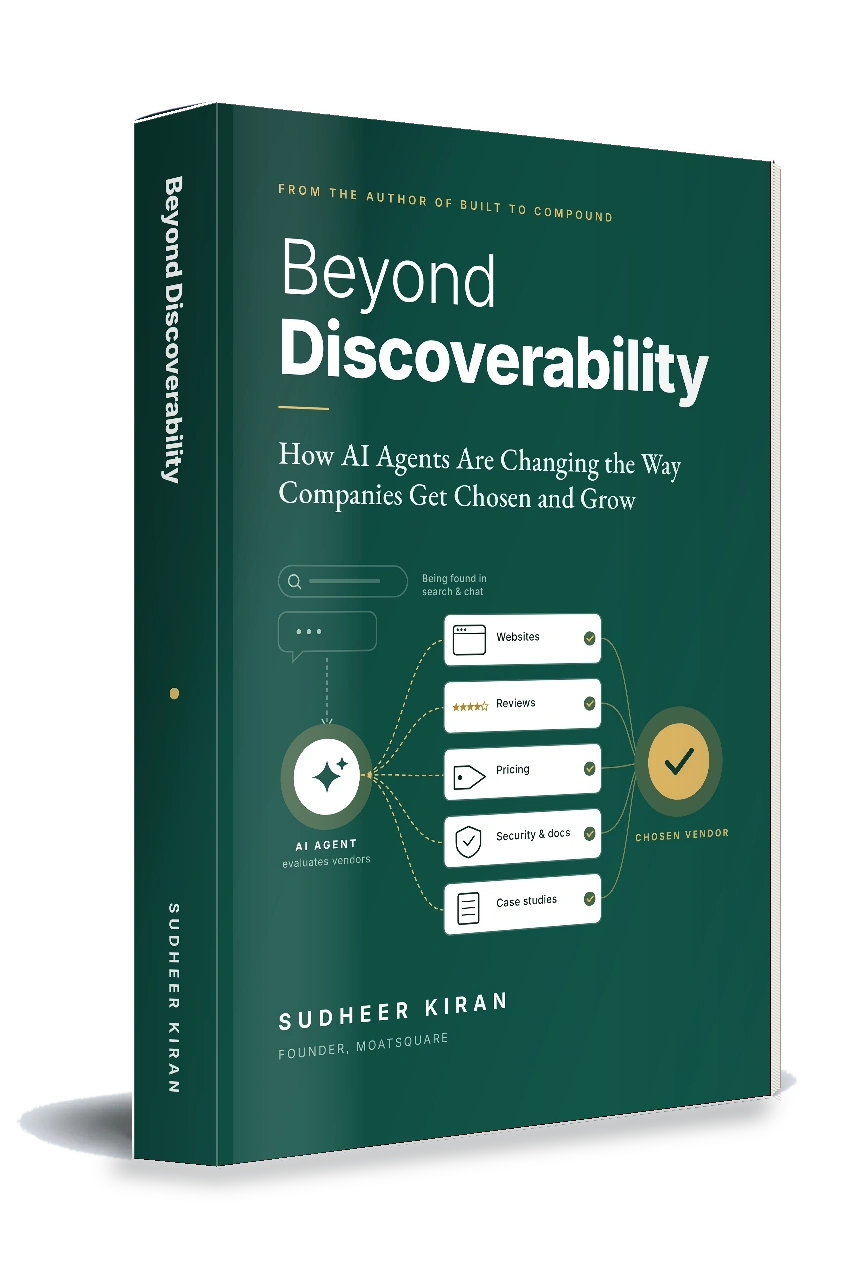
Beyond Discoverability
How AI Agents Choose Vendors
The Indispensable Marketer
VOL. 3 • 254 PAGES
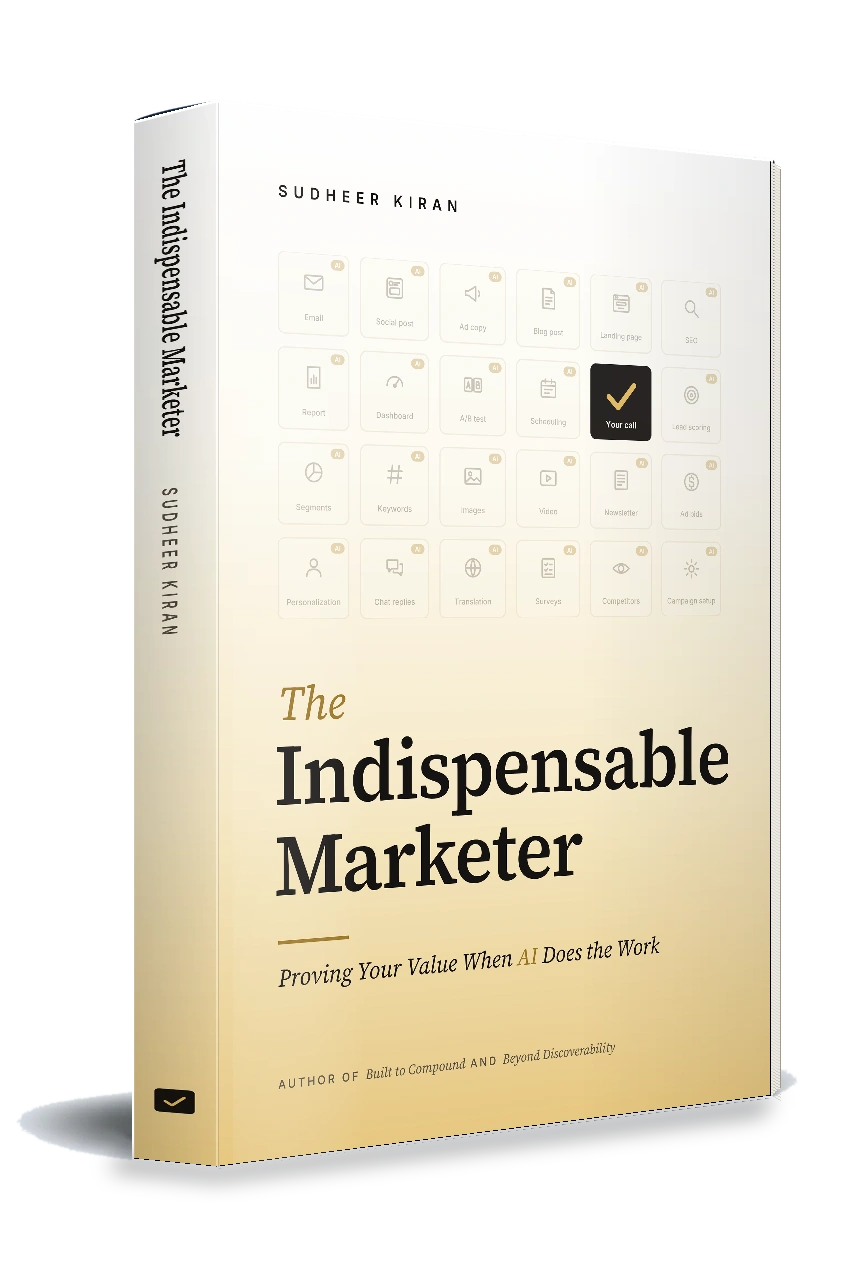
The Indispensable Marketer
Proving Value When AI Does the Work