TL;DR
- Google's November 2026 core update ran from November 10 to November 24, about 14 days. It was the third core update of the year, after March and May.
- Within hours of confirming it was done, Google announced a December core update. As of November 25 it hasn't started rolling out.
- This is the first time Google has pre-announced a core update and said what it targets: longer, more complex questions and better personalized results.
- Don't judge November's impact until at least December 1. If you're in retail, factor in Black Friday before you trust any comparison.
- Use the gap between the two updates to set a clean performance baseline.
I was halfway through my morning review of client dashboards when the Search Status Dashboard flagged the November core update as complete. Normally that's the cue for a few weeks of measured analysis. This time Google announced the next core update a few hours later, so the quiet period most of us plan around never arrived.
I don't think the headline here is that two core updates landed back to back. Google has done that before. What deserves our attention is that Google told us an update was coming before it started and said what it's meant to fix. That changes how we should prepare for it, and it says something about where Search is going.
November is done, but hold off on Search Console for a few more days
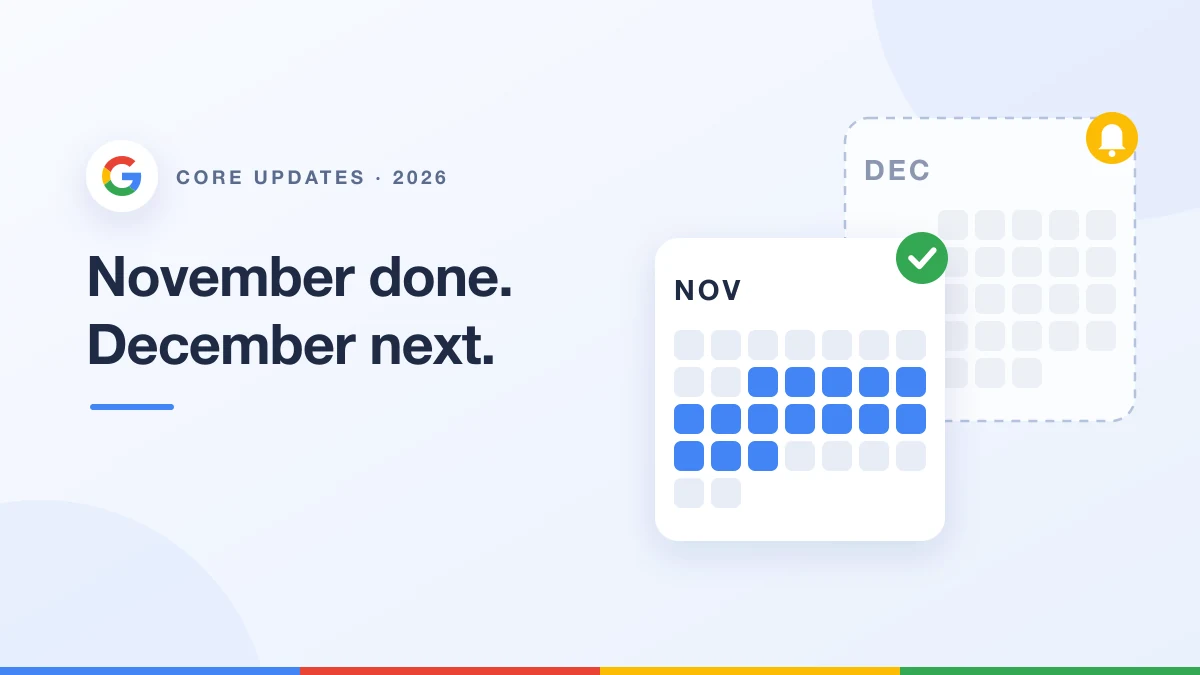
According to the Google Search Status Dashboard, the November 2026 core update started on November 10 and finished on November 24. That makes it the third confirmed core update of 2026, following the March update (March 27 to April 8) and the May update (May 21 to June 2). Google called it a regular update aimed at surfacing relevant, satisfying content across all kinds of sites, and as usual it didn't name any industries or content types that would win or lose.
Google's core update documentation says to wait until the rollout is complete and then allow at least a full week of post-rollout data before drawing conclusions. For November, that means December 1 at the earliest. I know how tempting it is to open Search Console on day one and start building a story for leadership, but a partial week of data usually produces the wrong story, and then the team spends a month defending it.
The timing adds a complication. As Search Engine Journal pointed out when the rollout began, retail sites comparing this period with a week before the update are really comparing holiday traffic with a normal week. If your business has any seasonality around Black Friday, compare year over year as well as week over week, or you'll credit the algorithm for what was really shopping behavior.
Why the pre-announcement matters more than the update itself
Google has long resisted pre-announcing core updates. In December 2025, John Mueller said pre-announcing for a fixed date "isn't possible", because quality improvements launch when they're ready and evaluated. Less than a year later, Google posted the December 2026 core update to the Search Status Dashboard before it went live, which Search Engine Land describes as the first pre-announcement of a core update.
It's worth being clear about what Google actually committed to. There's no release date and no expected duration, only that the update is scheduled for sometime in December. Mueller's point still holds, since Google hasn't promised a fixed date. What changed is that we now get a heads-up and a rough idea of the focus, which is more than this industry has ever had.
On the practical side, if your rankings are moving this week, the December update isn't the cause, because it isn't live. I've already seen people in industry chatter blaming a rollout that hasn't started, and that kind of attribution is how teams end up "fixing" the wrong things.
"Longer and more complex questions" is the AI search story under a core update label
Google says the December update will improve how its systems understand and rank content, including content that answers longer and more complex questions. My read is that this is the most important line in the announcement for B2B marketers, even though Google hasn't said how it works.
Think about how our buyers search now. Someone evaluating enterprise software doesn't stop at "best billing platform." They ask which billing platforms integrate with their CRM, what implementation looks like for a mid-size team, how pricing changes as they scale, and which alternatives suit their use case. That's one question with four requirements, and keyword matching was never built to answer it well. Buyers have learned to ask like this because AI assistants answer like this, and Search is clearly working to keep up.
I'm not going to guess at signals Google hasn't disclosed. The direction is still clear enough to act on, though. If your comparison pages, integration docs, pricing explainers and product documentation only answer the simple version of a buyer's question, this kind of improvement is designed to find a page that answers the full version, and that page may well belong to a competitor. In my work, most B2B sites have a homepage-level answer to almost every question and a decision-level answer to very few.
A useful exercise this week is to pull the longest queries already sending you impressions in Search Console, then read the landing page for each one as a buyer would. Does the page actually resolve the whole question, or does it make the reader open three more tabs? That gap is what I'd fix before December, and it would be worth fixing even if no update were coming.
Personalization makes your rank tracker a less honest witness
The second focus area is better personalized results for people who have personalization turned on. Google hasn't explained the mechanics, so anyone claiming to know exactly which signals change is guessing.
What we can say is that the more personalized Search becomes, the less a single tracked position tells you about what real buyers see. Two prospects in the same account can get different results for the same query. I still use rank tracking, but I treat it as a directional input next to impressions, clicks, landing-page performance and, most importantly, the pipeline organic search actually creates. If a team's main KPI is "average position," this update is a good reason to change that conversation with leadership now rather than after a confusing December report.
What I'd do between now and the December rollout
The window between the two updates is short, so I'd use it to get organized rather than to react.
- Lock in the dates. Record November 10 to 24 as the November rollout in your reporting so nobody later blames a December dip on the wrong event.
- Wait until December 1, then compare like with like. Put a full post-rollout week next to a comparable week before November 10, and add a year-over-year view if Black Friday affects your traffic.
- Separate noise from real decline. Moving from position 4 to 6 on a few queries is normal churn. A sustained drop across a cluster of important pages deserves a closer look, and Google suggests reviewing different search types separately where that's relevant.
- Snapshot your baseline before December starts. Record your top landing pages, priority queries, organic conversions and visibility trends. When the next rollout begins, you'll be comparing against a clean reference point instead of reconstructing one from memory.
- Watch the source, not the speculation. The Search Status Dashboard will tell you when December starts and ends. Third-party volatility trackers are useful context, but they shouldn't set your timeline.
- Don't chase forum tactics. If you see a real, sustained decline, Google's advice is to ask whether the affected content is genuinely helpful, reliable and built for visitors. That's a harder question than "what did everyone on X change this week," but it's the one that holds up across updates.
Google has given us more notice than it ever has before, and that removes the usual excuse that updates catch us off guard. The open question is whether your reporting can tell the difference between November, Black Friday and December, or whether it will lump all three into one bad month.
Frequently asked questions
When did Google's November 2026 core update start and finish?
It started on November 10 and finished on November 24, 2026, taking about 14 days.
When will the December 2026 core update roll out?
Google has only said it's scheduled for December 2026, with no exact date or duration. As of November 25 it hasn't started rolling out.
What is the December 2026 core update focused on?
Google says it will improve how its systems understand and rank content that answers longer and more complex questions, and improve personalized results for users who have personalization enabled.
Is this the first time Google has pre-announced a core update?
Yes, according to Search Engine Land's coverage. In December 2025, Google's John Mueller had said pre-announcing for a fixed date wasn't possible, and Google still hasn't given a fixed date for this one.
How long should we wait before analyzing the November core update?
Google recommends waiting until the rollout is complete and then allowing at least one full week of data, which means December 1 at the earliest. Retail and seasonal businesses should also account for Black Friday traffic.
Does a core update ranking drop mean my site was penalized?
No. Core updates are broad changes to Google's ranking systems, and a drop often means other pages are now judged more relevant. It doesn't mean your site broke a policy.
Get the monthly briefing
One high-signal edition a month on B2B growth, AI search, and agentic marketing. No noise, unsubscribe anytime.