Google's "Dive deeper" test in Discover looks like a small interface tweak. I think it tells us a lot about where discovery is going, and what marketers should be building while there's still time to adjust.
TL;DR
- Google is testing a "Dive deeper" button in Discover that opens an AI-written overview instead of the publisher's page. It starts with videos, and there are signs article cards will follow.
- This is the third time in about 15 months that Google has added an AI layer to Discover, so I'd pay more attention to the direction than to this particular design.
- Publishers are already hurting. Google search referrals to news sites dropped 33% in a year, and Discover dropped 21%.
- AI-referred visitors convert better than organic visitors, so the goal for B2B teams is protecting pipeline, not chasing every lost click.
- Companies with original knowledge, visible experts and their own audiences will feel Google's next change a lot less than everyone else.
What Google actually launched
A lot of the early commentary on this has been dramatic, so let's start with what we actually know.
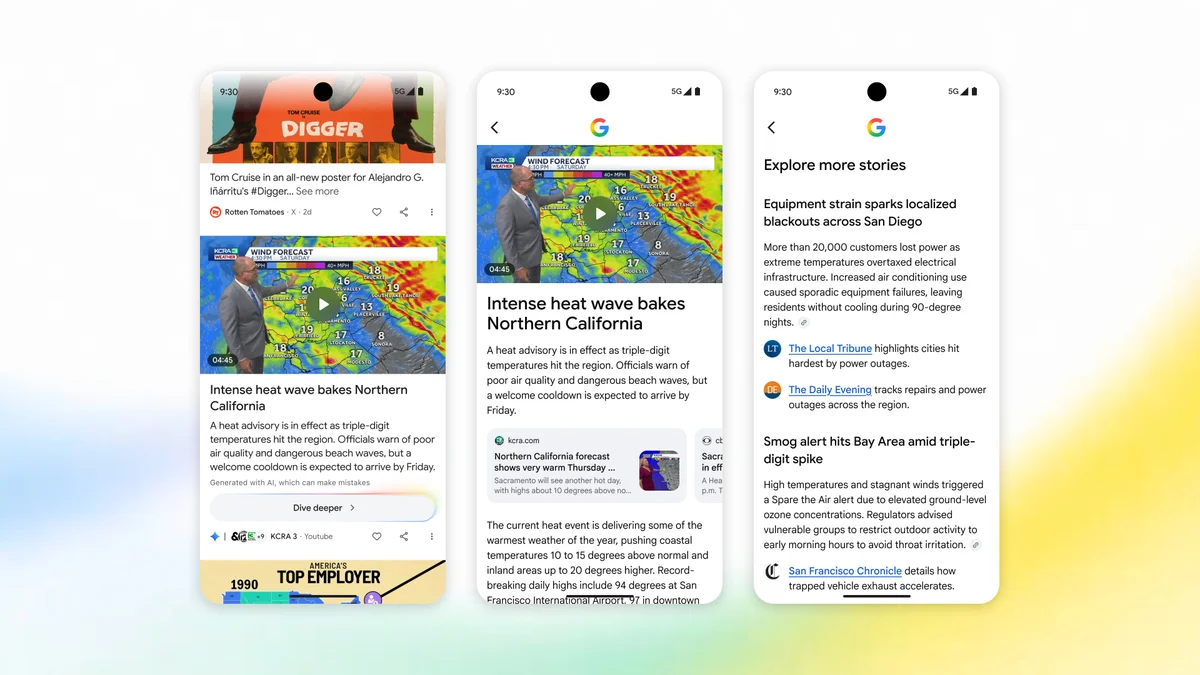
Robby Stein, who runs product for Google Search, announced the experiment on X on Friday, September 18. His post is below, along with the mockup Google shared.
Today we&\#39;re experimenting with a new way to make exploring a topic and discovering related web content easier in Discover.
— Robby Stein (@rmstein) September 18, 2026
By tapping “Dive deeper,” you’ll see a short topic overview with prominent links to related stories, community reactions & original reporting. We’ll test… pic.twitter.com/V9cyB1Ygli
When someone taps "Dive deeper" on a Discover card, they don't land on the publisher's content. They get a short AI-generated overview of the topic, and below it are links to related stories, community reactions and original reporting. Stein describes those links as prominent, though some publisher SEOs looking at the mockup have pointed out that the links are small and the headlines get cut off. Google is starting with videos and plans to try several designs over the next few weeks.
What Google didn't say is just as interesting. At the time of writing, there's no blog post or help page about the test, and no word on which markets are included, how many people will see it or whether publishers can opt out. There's no traffic data either. And an independent researcher has already found code strings pointing to article cards, so video probably won't be the end of it.
I don't buy the "Google is killing publishers" headlines. The links are still there. But a reader can now get the gist of a story before they ever reach the person who reported it, and for anyone who depends on that click, that's a meaningful change.
Why I don't see this as a one-off test
On its own, "Dive deeper" could pass for a routine experiment. The history makes it harder to shrug off.
In June 2025, DiscoverSnoop noticed a small U.S. test of AI-generated overviews inside Discover. It was limited to video, and Google never announced it. Later on, that test grew to include article summaries that pulled from several outlets at once, showing three lines by default with a "See more" option. Now we have a button that sends the tap itself to Google's overview.
Put those together and you can see Discover slowly changing roles. It used to point you toward something interesting to read. Increasingly, it wants to explain that thing to you itself. Three tests of the same idea in 15 months looks like a plan to me.
What publishers are already dealing with
News publishers are the canary here. Their whole model runs on referral traffic, so they see these shifts before the rest of us do.
The numbers are rough. Chartbeat data compiled for the Reuters Institute's 2026 trends report shows Google search traffic to more than 2,500 news sites fell by a third between November 2024 and November 2025. Discover traffic fell 21%, and in the U.S. the search decline was closer to 38%. When the Reuters Institute asked media leaders what they expect next, the average answer was another 43% drop over three years. About one in five expect to lose more than three quarters of their search traffic.
Some are already living that. Reach, one of the UK's biggest publishers, told investors its Discover traffic was down 46% in the second half of the year.
If you want to understand why, look at how people behave around AI summaries. Pew Research tracked real Google searches and found people clicked a regular search result in 8% of visits when an AI summary showed up. Without a summary, that number was 15%. The links inside the summaries barely got used at all, about 1% of visits. People were also more likely to just close the browser and move on after reading one.
Discover overviews aren't the same product as AI summaries in search. The behavior underneath is the same, though. Give people a decent answer up front and most of them won't dig further.
Where I've seen this
I've watched this happen at two companies I work with. One is a B2B marketing services firm where I'm the fractional CMO, and the other is a B2B SaaS company that makes an email campaigning tool. Google clicks dropped at both. Instead of fighting harder for the old rankings, we rebuilt both sites for answer engines, and over time AI channels started making up some of the difference.
It wasn't a one-for-one replacement. The traffic from AI was smaller. But those visitors showed up knowing a lot more about what they needed, and they converted better.
That lines up with what the wider data shows. Across the B2B websites Demandbase tracks, ChatGPT referrals grew 303% between June 2025 and June 2026. And Ruler Analytics' 2026 conversion benchmarksput AI-referred visitors at a 5.8% conversion rate, which is higher than paid search (5.4%) and organic search (4.9%).
To make that concrete for a typical B2B site, say you get 10,000 organic visits a month and lose 3,000 of them to AI answers. At 4.9%, that's about 147 conversions gone. At 5.8%, you'd need around 2,500 AI-referred visits to get those conversions back. So your traffic chart can look worse while your pipeline holds up fine.
From referral to mediation
Most of us learned digital marketing as a sequence. Someone sees you, clicks, lands on your site and converts. We built SEO around that sequence, and content calendars, and analytics, and entire teams.
The click was never really the point, though. It was just the easiest way to prove we'd gotten someone's attention. AI is pulling those two things apart. A buyer can now read the key findings from our research without downloading the report. They can compare us with three competitors without opening a single vendor website. They can form an opinion of our product from a summary we had no hand in writing.
People call this "zero-click," and I think that undersells it. The platform isn't just keeping the click. It's reading our content, deciding what it means, mixing it with other sources and answering the buyer's question on its own terms. Our website becomes an optional next step.
So the path now looks more like this: the buyer finds us, the AI interprets us, our authority decides how much weight that interpretation carries, and then the buyer chooses. That's a harder game to win. It's also one where companies with real expertise can beat companies that simply publish more.
Clients ask me a lot where AI agents are taking this. My honest answer is that it depends on how much the buyer is willing to hand over.
Some buyers will just ask an agent to find solutions to a problem. The agent comes back with a longlist, and the human takes it from there. Others will ask the agent to look at a few options, compare them and recommend one, so the agent is effectively building the shortlist. And some will go all the way and tell the agent to pick the right solution and get it set up.
Each of those asks something different of us as vendors. To make the longlist, buyers and agents have to be able to find us and understand quickly what we do. To survive a comparison, we need information an agent can actually check, like pricing, integrations, customer proof and security documentation. And to get picked and purchased, we have to be easy to buy from. That means things like self-serve trials, clear packaging and onboarding that doesn't depend on a sales call.
In every one of those scenarios, most of the decision gets made before anyone visits our website. The site is becoming the place where buyers double-check a shortlist the AI already put together. I'd encourage every team to ask which of those three levels they're honestly ready for right now. For most companies I talk to, it's the first one, and just barely.
Why generic content loses first
AI made content cheap. That's helped a lot of teams publish more, but it's also made most of what gets published interchangeable. If every company can put out "What is account-based marketing?" in an afternoon, nobody gains much by adding one more. Chances are it gets blended into an AI answer with nine similar pieces, and nobody gets the credit.
Publishers figured this out already. Most of them plan to put more resources into original reporting, analysis and human stories, because that's the work chatbots and aggregators have the hardest time copying. I think brands need to make the same move.
Think about two pieces a B2B marketing team might publish. One is a blog post called "10 B2B Marketing Trends for 2027." The other is a report called "The 2027 B2B Buyer Discovery Benchmark: What 5,000 Marketing Leaders Told Us."
Anyone can write the first one. An AI can summarize it in seconds, and a competitor can publish a better version by next week. The second one has original data behind it, a methodology and people who can explain what the findings mean. Journalists can quote it. Your sales team can use it in deals. And an AI system has an actual reason to cite it, because the information doesn't exist anywhere else.
From Built to Compound
In my book, I call assets like that benchmark Commercial Control Points. They're the things that keep their value when platforms and algorithms change, and I've found the idea works well as a quick filter for any content plan.
Before something goes on the calendar, I'd ask four questions about it. Do we actually own it, or could a competitor publish the same piece tomorrow? Is it defensible, meaning it draws on data, experience or access that others don't have? Does it compound, so it gets more valuable each time someone cites it, shares it or we update it? And is it machine-readable, so an AI system can find it, understand it and attribute it to us?
A generic trends post fails every one of those questions. A proprietary benchmark passes all four.
GEO starts with a harder question
Almost every GEO conversation I hear starts with some version of "How do we get ChatGPT to mention us?"
I'd flip that around. Why would ChatGPT have any good reason to mention us in the first place? Maybe we have the best dataset in our category. Maybe our founder has spent 20 years in this market and sees patterns others miss. Maybe we've run experiments nobody else has published, or we have insight from hundreds of customers that nobody outside the company has seen. That's what earns citations.
Structured data, clean entities, consistent terminology and credible authors all help, because they make it easier for machines to read and trust what we know. But they can't make up for not knowing anything distinctive.
What AEO actually looked like for us
For both of those clients, AEO wasn't a single project or a quick fix. It was a full strategy, and each piece depended on the others.
We revamped the messaging first in terms of priority, because an AI system can only repeat what a company says clearly and consistently. If your positioning is vague, the AI's summary of you will be vague too. We implemented schema so machines could get a structured picture of who the company is, what it offers and how its content connects. We ran a technical SEO audit, because if crawlers can't properly access and index the site, none of the other work gets seen. And we built a content roadmap around the questions buyers actually ask AI assistants, which are often very different from the keywords they type into Google.
Take out any one of those and the rest gets weaker. Great messaging without schema is harder for machines to interpret. Schema without strong content just describes pages nobody has a reason to cite.
Rented reach and owned reach
I'm not suggesting anyone pull back from Google, LinkedIn, YouTube or Reddit. They're good distribution channels and we should keep using them.
The problem is that whoever controls the algorithm also controls your relationship with the audience. Discover has made that pretty clear this year, first through the traffic numbers and now through a single button.
The assets that build up over time are the ones you can reach without a platform's permission. Your email list is one. So is a community, an event series, a podcast or a customer base that actually talks to you. First-party data counts too. And brand preference, the thing that makes a buyer ask for you by name, is probably the most valuable and the slowest to build. Staying off the big platforms would be a mistake. Letting them account for most of your growth is a much bigger one.
Why human expertise matters more now
There's something a little counterintuitive going on. As AI makes information cheaper, people who can interpret that information become more valuable.
Publishers see it. When the Reuters Institute surveyed media leaders, 76% said they plan to get their journalists behaving more like creators this year.
Brands should take the hint. Your CEO, product leaders, researchers and even your customers should be out in the market with real opinions, not hidden behind a corporate account. AI can summarize a finding just fine. Buyers still decide for themselves whose take on it they believe.
Rebuild the dashboard
If our reports still revolve around traffic, we'll keep optimizing for traffic. I'd break reporting into four areas instead:
| Asset | What to measure |
|---|---|
| Visibility | Search visibility, AI mentions and citations, Discover impressions |
| Authority | Research citations, backlinks, expert mentions, branded search |
| Owned audience | Email subscribers, community members, direct and returning visitors |
| Business impact | Pipeline, conversion, revenue, retention, LTV |
Traffic still belongs on the dashboard. It just shouldn't be the number everyone looks at first.
A question for your next leadership meeting
If I could get one question in front of every marketing leadership team, it would be this: if Google sent us half as much traffic next year, would we still grow?
When the answer is no, the reflex is to hand it to the SEO team and ask them to fix it. I'd push the conversation somewhere else and ask how much of our demand we actually own. Traffic can vanish with one product update from Google. Authority doesn't disappear that way, because it goes wherever your buyers go.
What we can do this quarter
- Look at how dependent we are on referrals. Figure out what share of pipeline starts with organic search and Discover. If one platform is driving most of it, that's a concentration risk, and leadership should know about it.
- Pick one proprietary asset and commit to it. A benchmark, a dataset or an annual survey works well, especially if it's something we can update every year.
- Get two internal experts out in public with a clear point of view and a regular publishing schedule.
- Clean up the machine-readable basics. That means schema, consistent entity names, real author pages and category terms we use the same way everywhere.
- Choose one owned channel and grow it on purpose. Set a subscriber goal and report on it next to traffic.
- Start tracking AI visibility every month. Run our top 20 buyer questions through ChatGPT, Gemini, Perplexity and Google's AI Mode, note whether we show up, and give AI referrals their own channel in analytics.
Where this is heading
I don't know what "Dive deeper" will look like in six months, and I doubt Google does yet either, since it's still testing designs. We don't really need to know. Platforms are steadily taking over more of what used to happen after the click, from finding and explaining information to comparing options and recommending them. More and more, they'll be choosing too.
The companies that come out of this in good shape won't be the ones with the most traffic. They'll be the ones these platforms trust enough to cite.
FAQs
What is Google's "Dive deeper" feature?
It's an experimental button in Google Discover. Tapping it opens a short AI-generated overview of a topic, with links to related stories, community reactions and original reporting. Google announced the test on September 18, 2026, and it's starting with video cards.
Does "Dive deeper" remove publisher links?
No. Publisher links show up inside the overview. The worry is that the overview answers enough of the question that fewer people bother clicking through. Google hasn't shared any traffic data on the test yet.
Is "Dive deeper" available everywhere?
Not yet. Google hasn't said which countries are included or how many people are seeing it, and it has said the design will change as testing goes on.
Does AI referral traffic convert better than organic search?
On average, yes. Ruler Analytics' 2026 benchmarks found AI-referred visitors converting at 5.8%, compared with 4.9% for organic search. There are fewer of these visitors, but they tend to arrive further along in their research.
Is SEO dead?
No. Technical SEO, good content and a well-built site still matter, and AEO depends on all three. What's changed is the goal. Earning clicks is still part of it, but so is getting cited inside AI-generated answers.
What's the difference between AEO and GEO?
They overlap a lot, and people often use them interchangeably. Both are about making your information easy for AI systems to understand, trust and cite. AEO (Answer Engine Optimization) usually refers to answer-style experiences, and GEO (Generative Engine Optimization) tends to cover generative AI search more broadly.
How should B2B brands respond to zero-click discovery?
Treat AEO as a full strategy that covers messaging, structured data, technical SEO and content built around real buyer questions. At the same time, invest in original research, get your experts visible and build channels you own, so your growth isn't tied to any one platform's referrals.

Written by Sudheer Kiran
Full Stack Growth Marketing Professional & Fractional CMOHey, I'm Sudheer. I've spent nearly two decades working in growth marketing—mostly with B2B SaaS companies, agencies, and startups. I help businesses find smart, scalable ways to grow through digital transformation, brand strategy, and marketing that actually converts.